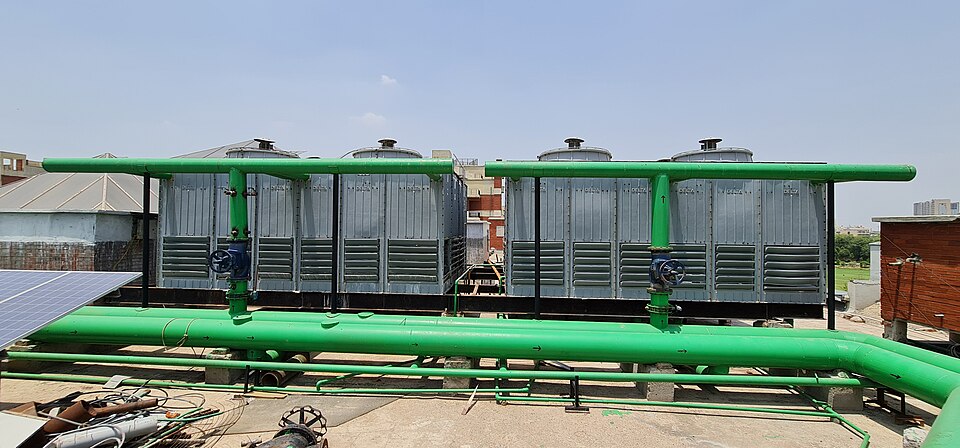

中英術語 Key Terms
- 冷卻塔
- cooling tower
- 進風濕球
- entering-air wet bulb
- 溫降
- range
- 逼近度
- approach
學習目標 Learning Objective
區分冷卻塔溫降與逼近度,說明室外濕球為何重要。
Distinguish range, approach and the effect of weather.
核心概念 Key Concepts
水和空氣接觸時,部分水蒸發,帶走熱量。空氣越潮,蒸發降溫的餘地通常越小。對一般蒸發式冷卻塔,出水溫度通常高於進風濕球。逆流和橫流描述水與空氣穿過塔內的相對方向。自然通風利用密度差,機械通風由風機推入或抽出空氣。
Evaporation cools water as it contacts air. Wetter air generally limits evaporative cooling. Typical leaving water stays above entering wet bulb. Counterflow and crossflow describe relative air and water directions. Draft may be natural or fan-driven.
公式與單位 Formulas and Units
- 溫降 range = 進塔水溫 − 出塔水溫。
- 逼近度 approach = 出塔水溫 − 進塔空氣濕球。兩個量都用 K 或 °C 溫差,熱量另用水流量乘比熱和溫降。
Range = entering water minus leaving water. Approach = leaving water minus entering wet bulb. Use K. Multiply water flow, heat capacity and range for heat rejection.
常見錯誤 Common Mistakes
- 用乾球算逼近度。確認氣象資料是入塔空氣濕球。
- 只憑進出水溫比較兩塔。同時比較氣候及流量工況。
Use wet bulb, not dry bulb. Compare climate and water flow when comparing towers.
例題 Worked Example
呼出計算器 Open Calculator進水 33°C、出水 28°C、進風濕球 24°C。算溫降與逼近度。
- 進水 33°C Water in 33°C
- 出水 28°C Water out 28°C
- 進風濕球 24°C Entering wet bulb 24°C
展開解題步驟 Show Solution
溫降 33 − 28 = 5 K;逼近度 28 − 24 = 4 K。
完整示範與練習銜接 Worked Method and Practice Bridge
沿水路相減:溫降 5 K;出水與進風濕球相比,逼近度 4 K。第二個差直接用氣象條件,兩個差不能互換。 Water range is 5 K and approach to entering wet bulb is 4 K. Only the second difference directly uses the ambient condition.
1 個小練習 Practice Problem
呼出計算器 Open Calculator紙上監測點顯示進水 34°C、出水 29°C、進風濕球 25°C。算溫降和逼近度,指出哪一個數字與氣象資料直接相關。
作答後核對答案 Check Answer
溫降 34 − 29 = 5 K,逼近度 29 − 25 = 4 K。逼近度用到進風濕球,因此與氣象資料直接相關。
延伸思考與參考 Further Study and References
1 個蘇格拉底式問題 Socratic Question
若濕球上升而出水溫度保持不變,哪個差值先改變?該看什麼才能判斷是否用了更多風機能量?
If wet bulb rises at constant leaving water, what changes and how would you check fan work?
公開參考連結佔位符 Public Reference Placeholder
〔待導師填入:公開的蒸發式冷卻塔性能及濕球說明〕